Store Operations • Wage Optimization

Wage Optimization

Most retailers do not have a payroll problem. They have a labor alignment problem. The goal is not simply reducing hours — it is deploying labor more intelligently than last year.
Labor optimization without context creates the wrong behavior.
The best labor model is not the lowest payroll model. It is the highest-profit operational model.
What it is
The issue in plain language
Retailers already have payroll reports. The problem is that payroll reports rarely show the full operational picture. Labor performance is driven by traffic, conversion, sales mix, peak periods, operational workload, staffing quality, and historical demand patterns.
The solution
Improve labor productivity, not just payroll percentage
Wage optimization aligns labor investment to customer demand, traffic patterns, conversion opportunity, operational execution, and profitability. It helps teams understand whether they should reduce hours, rebalance hours, or add coverage where the opportunity justifies it.
Why last year matters
Labor optimization without historical comparison is dangerous
A store may look overstaffed today, but traffic may be higher than last year. Or payroll percentage may look better, while conversion has declined because peak selling periods are now understaffed. Smart retailers optimize labor against demand patterns over time — not arbitrary payroll targets.
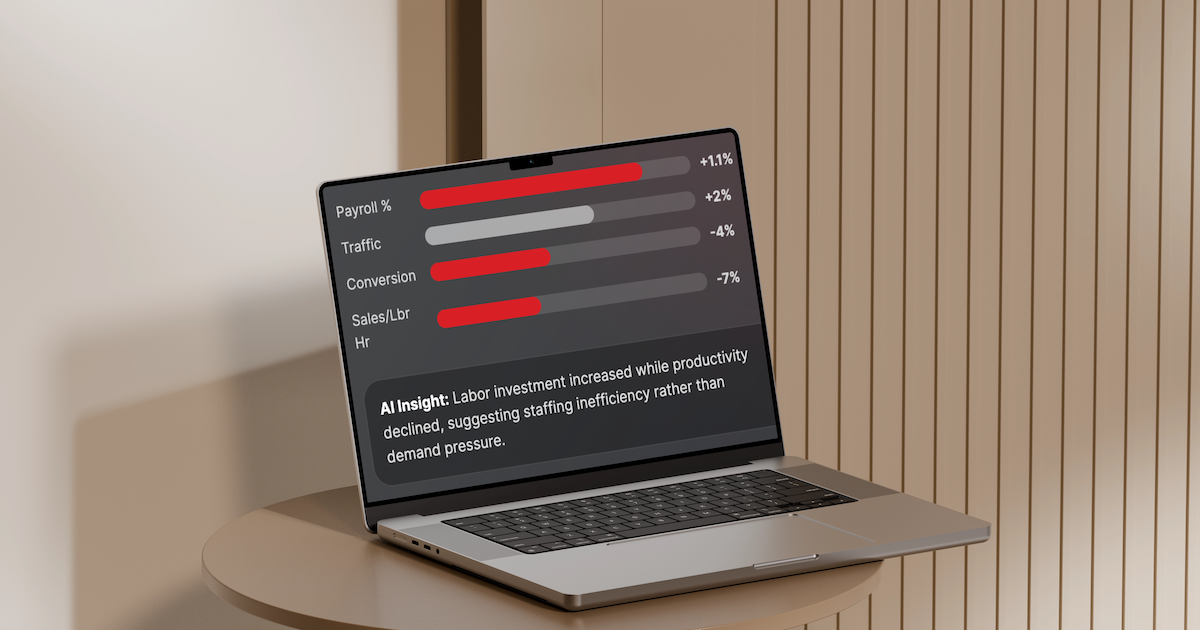
MetricThis YearLast YearChangeInterpretation
Payroll %14.2%13.1%↑ 1.1 ptsLabor cost increased
Traffic+2%BaselineSlightly upDemand does not explain full labor increase
Conversion-4%BaselineDownCoverage or selling execution may be misaligned
Sales / Labor Hour-7%BaselineDownProductivity drift requires action
Real-world patterns

What this looks like in a real apparel operation

Overstaffed low-demand periods
Too many labor hours during weak traffic windows.
AI: Tuesday labor is 18% above LY while traffic is flat.
Understaffed peak periods
Strong traffic but weak conversion during critical selling windows.
AI: Saturday traffic increased while labor remained flat.
Payroll cuts damaging sales
Managers hit payroll targets but reduce selling capacity.
AI: Payroll improved, but conversion fell 4.8% vs LY.
Recurring overtime dependency
The same people repeatedly absorb excessive hours.
AI: Three employees account for 41% of OT exposure.
Who should care
Why this matters by role
Metrics that matter
The wage optimization signal set
Payroll percentage is only one part of the story. The strongest view combines cost, productivity, customer demand, and operational output.
Why this matters financially

Small labor improvements create large operational leverage

The ROI is not just labor reduction. It is better alignment: fewer low-value hours, stronger peak coverage, higher productivity, and less management time spent diagnosing the same issues repeatedly.
Estimate Annual Payroll Opportunity
Annual sales
Payroll %
Prod improvement %
Annual payroll base
$138.6M
Annual opportunity
$2.8M
This directional calculator estimates the value of improving labor productivity against the current payroll base. It does not include potential sales lift from better peak-hour coverage.

Workflow

How AI-driven wage optimization works

This page is not just about payroll control. It is about a repeatable method for aligning labor with demand, productivity, and execution.
Integrate
Combine payroll, scheduling, sales, traffic, conversion, and operational KPIs.
Compare
Compare labor performance to last year, prior periods, comparable stores, and expected demand curves.
Detect
Identify labor inefficiencies, productivity drift, overtime exposure, and peak-hour understaffing.
Diagnose
Explain what changed, where it changed, and likely operational causes.
Prioritize
Focus leadership attention on the largest opportunities and highest-risk stores.
Act
Rebalance labor, reduce low-value shifts, increase peak coverage, or correct overtime dependency.
Track
Measure productivity, payroll efficiency, conversion impact, and consistency over time.
Where AI helps

Use AI to move from payroll reports to operational action

Different roles need different answers. Store teams need the next action. Territory teams need the pattern. Executives need the trend and the financial impact.

Optimize labor intelligently — not blindly.

See where labor investment improves performance, damages conversion, creates inefficiency, or drives profitability using operational intelligence designed for retail.

More 2-Minute Operational Insights

Continue the series

Explore other fast, practical issue pages built around the same pattern: signal, impact, workflow, and action.
Next up:
Store Score
Next up:
Product Overuse
Next up:
Overtime Drift
Next up:
Discount Leakage

Book a Demo