
Store Operations • Loss Prevention

Loss Prevention

Shrink is not always one big event. In apparel retail, loss often shows up as small patterns across discounts, refunds, voids, transfers, stock accuracy, and operational behavior.
Most retailers see the loss after it happens. The opportunity is detecting the pattern before it spreads.
Loss prevention is not just theft detection. It is operational intelligence applied to margin leakage, inventory accuracy, and store behavior.
The Issue
Loss prevention is often treated as an event, but the signals usually appear earlier.

Traditional loss prevention is often reactive. A stocktake reveals shrink. A refund report looks unusual. A manager notices a pattern. By then, the issue may already have affected margin, inventory accuracy, and store confidence.

The Reframe
The goal is not more surveillance. It is earlier detection of operational drift.
tRS helps connect loss-related signals across POS, inventory, associate activity, transfers, discounts, and returns so teams can see where behavior does not match the expected operational pattern.
Operational Patterns

What apparel loss prevention looks like in reality

The issue is rarely one obvious metric. It is usually a pattern across several weak signals that become meaningful when viewed together.
Refund & Return Anomalies
Refund rates, no-receipt returns, repeated item returns, or high-value refunds can indicate policy leakage or process weakness.
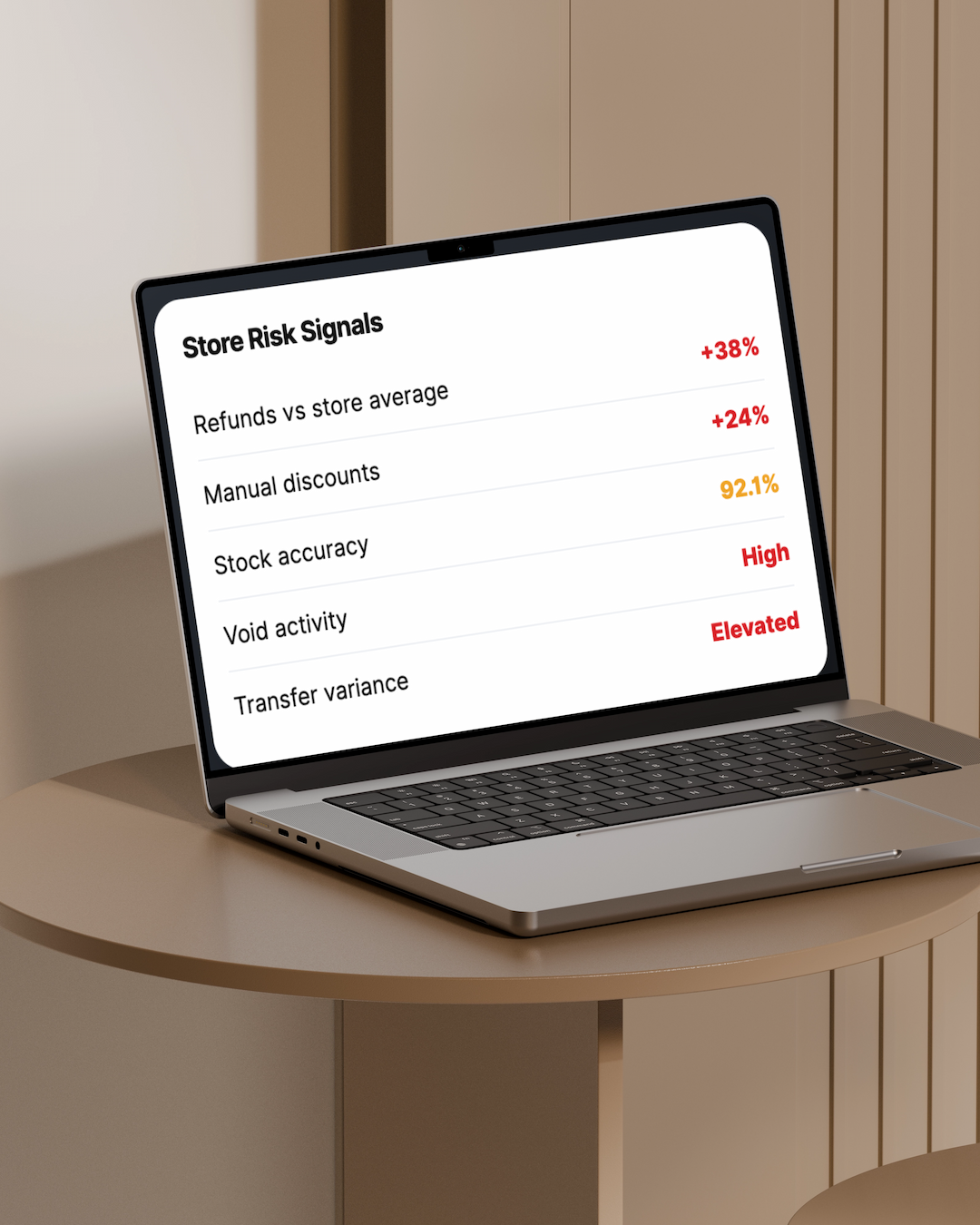
AI Insight: Refund activity is 38% above comparable stores and concentrated after 5 PM on weekdays.
Manual Discount Leakage
Discounts outside approved promotional logic can erode margin and indicate poor compliance or intentional misuse.
AI Insight: Manual discounts increased 24% versus last year while promotional activity remained flat.
Void & Transaction Editing
Voids, cancels, transaction reversals, and post-sale edits may signal training issues or risk behavior.
AI Insight: Void activity is 2.1x peer average and linked to a narrow set of associates.
Stock Accuracy Drift
Inventory variance may reflect theft, receiving errors, transfer issues, poor scanning discipline, or execution gaps.
AI Insight: High-risk SKUs show repeated variance across stocktake, transfer, and sales records.
Transfer & Receiving Variance
Late, missing, or mismatched transfers can create false inventory availability and hide operational loss.
AI Insight: Transfer variance is concentrated between four stores and recurring product categories.
Associate-Level Risk Concentration
Loss-related activity may cluster around particular associates, shifts, or manager override behavior.
AI Insight: Two associates account for 46% of manual overrides despite representing 14% of transactions.
Why It Matters

Loss prevention is margin protection.

In apparel retail, loss does not only show up as missing stock. It shows up as margin dilution, bad inventory signals, poor replenishment decisions, operational noise, and weaker trust in the data.
Risk Signal Example
AI can combine weak signals into a stronger operational alert
Signal Store Avg Store 42 Risk
Refund Rate 4.8% 6.6% High
Manual Discounts 12.1% 19.4% High
Void Activity 1.3% 2.9% High
Stock Accuracy 96.4% 92.1% Elevated
AI Interpretation: No single metric proves loss. But the combined pattern suggests Store 42 deserves prioritized review.
Financial Impact
The ROI is in detecting small leaks before they become structural loss.
Loss prevention value comes from reducing margin leakage, improving inventory accuracy, and focusing investigation time where the risk is highest.
Example Opportunity Areas
Unauthorized discounts
Refund leakage
Stock variance
Investigation time
Even small improvements in discount control, refund integrity, and stock accuracy can materially improve profitability across a store network.

Workflow

How AI-driven loss prevention analysis works

Integrate
Combine POS, refunds, discounts, inventory, transfers, associate activity, and stocktake data.
Normalize
Compare stores and associates fairly against transaction volume, store type, and operating context.
Detect
Identify abnormal refunds, voids, discounts, stock variance, transfers, and override behavior.
Correlate
Connect weak signals across multiple systems to find meaningful operational risk patterns.
Prioritize
Rank stores, associates, products, and transaction types by risk and commercial exposure.
Act
Create targeted review tasks for regional leaders, store managers, or loss prevention teams.
Track
Monitor whether risk signals improve after coaching, process changes, or policy enforcement.
AI Questions

Questions AI can answer instantly

Make the invisible leaks visible.

AI-driven operational intelligence for apparel loss prevention, margin protection, inventory accuracy, and store execution.

More 2-Minute Operational Insights

Continue the series

Explore other fast, practical issue pages built around the same pattern: signal, impact, workflow, and action.
Next up:
Store Score
Next up:
Product Overuse
Next up:
Overtime Drift
Next up:
Discount Leakage